How to Strengthen Your Luteal Phase: What to Look At After Ovulation
You’re ovulating.
You’re timing everything.
And yet pregnancy still isn’t happening.
When that’s the case, we don’t only want to look at whether you’re ovulating.
We also want to understand what happens after ovulation.
That second half of your cycle is called the luteal phase, and it’s when progesterone rises and your uterine lining prepares for the possibility of implantation.
So if you’ve noticed spotting before your period, a very short time between ovulation and your next cycle, or other changes after ovulation, your luteal phase may be one of the pieces worth looking at more closely.
Not because a short luteal phase automatically means something is wrong.
And not because you need to “fix” your body.
But because your cycle is giving you information.
What Is the Luteal Phase?
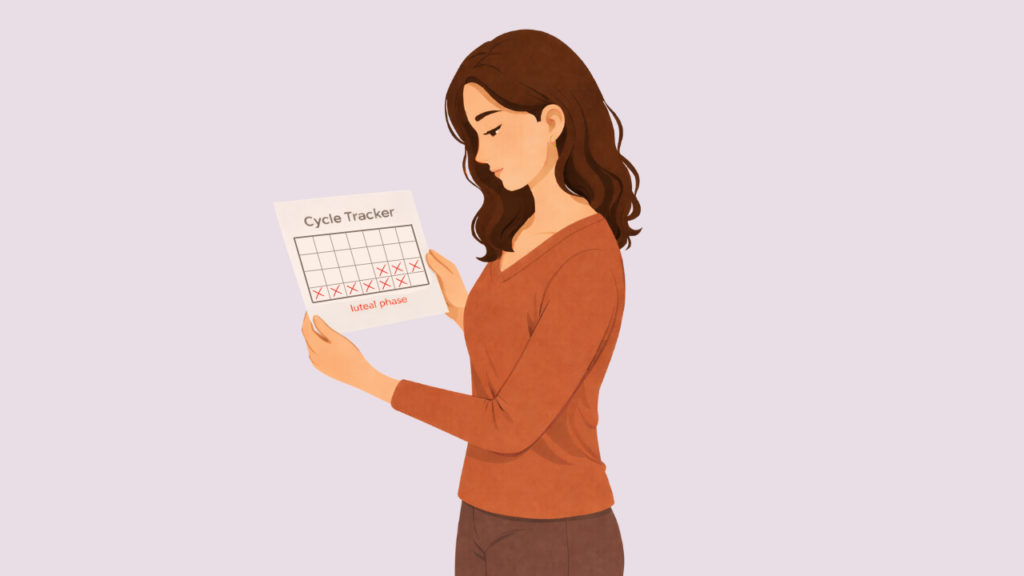
Your luteal phase begins after ovulation and ends when your next period begins.
After you release an egg, the follicle that released it becomes something called the corpus luteum.
The corpus luteum produces progesterone, which helps prepare and maintain the uterine lining during this part of your cycle.
A typical luteal phase is often around 12 to 14 days, although there’s normal variation from woman to woman. Current fertility guidance considers a luteal phase of about 11 to 17 days within a typical range, while a consistently very short luteal phase may deserve a closer look.
This is where tracking is helpful.
We’re not looking for a perfectly identical cycle every month.
We’re looking for patterns.
When Your Luteal Phase May Deserve a Closer Look
You might want to pay more attention to the second half of your cycle if you regularly notice:
- Fewer than about 10 days between ovulation and your next period
- Spotting for several days before your period
- Difficulty identifying a clear ovulation pattern
- Significant PMS after ovulation
- Cycles that vary considerably from month to month
- A history that makes your provider want to evaluate ovulation or progesterone more closely
One short luteal phase does not automatically mean you have luteal phase deficiency.
In fact, shorter luteal phases can sometimes occur even in women without infertility. That’s why we want to look for a repeated pattern and consider what else is happening in your cycle.
If you’re noticing spotting before your period or wondering whether progesterone may be part of the picture, learning more about low progesterone symptoms and fertility can help you understand what deserves a closer look.
Progesterone Matters, But One Number Doesn’t Tell Us Everything
Progesterone is incredibly important after ovulation.
But this is something we want women to understand:
One progesterone result does not tell us whether your luteal phase is “good” or “bad.”
Progesterone is released in pulses and can change significantly within just a few hours. A properly timed progesterone test can help confirm that ovulation occurred, but one blood draw cannot reliably measure the overall quality of your luteal phase.
Timing matters too.
If your provider is checking progesterone, it generally makes more sense to time testing based on your ovulation, rather than automatically testing everyone on cycle day 21.
That’s another reason knowing your cycle can be so helpful.
What Can Affect the Time After Ovulation?
If your luteal phase is consistently short, the goal shouldn’t be to throw progesterone, supplements, and fertility hacks at the problem.
We want to ask why.
Things worth looking at may include:
- Ovulation itself
- Thyroid function
- Nutrition and whether you’re eating enough
- Significant weight changes
- Intense or excessive exercise
- Blood sugar patterns
- Sleep
- Stress load
- Other hormone patterns
- Your overall health
Some medical conditions can affect normal ovulatory and luteal function, which is why repeated changes deserve proper evaluation rather than assuming the problem is simply “low progesterone.”
If cravings, energy crashes, PMOS, or irregular ovulation are part of your story, understanding insulin resistance and fertility may help you see another piece of the bigger picture.
How to Support Your Luteal Phase Naturally
There isn’t one food, supplement, or treatment that guarantees a longer luteal phase.
And I actually think that’s an important shift to make.
Instead of asking:
“How do I force my progesterone higher?”
We want to ask:
“What does my body need to support healthy ovulation and the phase that comes after it?”
Start With Good Ovulation
Your luteal phase begins with ovulation.
So one of the first things we want to understand is whether you’re ovulating consistently and whether the follicle developing before ovulation is getting the support it needs.
This is why we don’t treat the luteal phase like an isolated two-week window.
The entire cycle matters.
Your follicular phase matters.
Your nutrition matters.
Your metabolic health matters.
And the health of the ovulation that happens before the luteal phase matters too.
Make Sure You’re Eating Enough
Your body needs adequate energy and nutrients to support reproductive hormone production.
That doesn’t mean following a perfect “fertility diet.”
It means making sure you’re actually nourishing yourself.
We start with basics like:
- Enough protein
- Regular meals
- Healthy fats
- Fiber-rich vegetables and whole foods
- Steadier blood sugar
- Enough overall food
- Good hydration
If you’re skipping meals, chronically dieting, or exercising intensely without adequately fueling your body, that’s worth looking at.
The goal is not to become more restrictive.
It’s to give your body what it needs.
Look at Sleep and Stress Without Blaming Yourself
Stress belongs in the fertility conversation.
But we’re never going to tell you to “just relax.”
Your nervous system is constantly responding to your sleep, workload, emotions, nourishment, illness, exercise, and everything else happening in your life.
Supporting it may help your overall health and make the fertility journey feel much more manageable.
That could mean:
- Getting more consistent sleep
- Eating regularly
- Pulling back from over-exercising
- Acupuncture
- Breathwork
- EFT
- Movement
- Getting outside
- Asking for help
- Giving yourself actual recovery time
Stress is one piece of the picture.
It’s not a reason to blame yourself for your fertility.
If trying to conceive has left your nervous system constantly on alert, learning more about fertility anxiety may help you understand why emotional support belongs in fertility care too.
Pay Attention to the Whole Cycle
One of the biggest things we teach women at AIM is that your cycle gives you information all month long.
Not just when your period starts.
Look at:
- When you ovulate
- Your cervical mucus
- How many days pass between ovulation and your period
- Whether you spot before your period
- Your flow
- Your PMS symptoms
- Your sleep
- Your energy
- Changes from one cycle to the next
The goal isn’t to obsess over every symptom.
It’s to understand your patterns.
If you want help making sense of those patterns, download the free Decoding Your Cycle guide and start looking at your cycle as information instead of something you have to guess your way through.
What If You’ve Experienced Pregnancy Loss?
This is an important distinction.
If you’ve experienced an early pregnancy loss, it can be tempting to immediately assume that your progesterone was too low or your luteal phase wasn’t strong enough.
But pregnancy loss is complicated.
Progesterone plays an essential role in early pregnancy, but current evidence does not support assuming that an isolated luteal phase problem caused a miscarriage. There can be many possible contributors, and recurrent loss deserves a broader evaluation.
We don’t want you looking back and wondering:
“Was this something I did wrong?”
Your loss is not proof that you failed to support your body well enough.
If loss has happened more than once, the better question is:
What deserves a closer look before we try again?
If you’ve experienced repeated loss, our guide to recurrent miscarriage testing can help you understand why looking beyond progesterone alone may matter.
How AIM Women’s Wellness Center Supports Luteal Phase Health
At AIM Women’s Wellness Center, we don’t look at the luteal phase in isolation.
We want to understand the entire cycle.
- When are you ovulating?
- How long is your luteal phase?
- Are you spotting?
- What does your period look like?
- What do your symptoms tell us?
- How are you eating and sleeping?
- Is blood sugar part of the picture?
- What has already been tested?
- What else may deserve attention?
Depending on what we find, support may include acupuncture, Chinese medicine, nutrition, supplement guidance, cycle education, fertility coaching, nervous system support, and collaboration with your medical or fertility providers.
The goal isn’t to “fix” your luteal phase with one treatment.
It’s to understand what your body is showing us and support the areas that actually need attention.
Your Luteal Phase Is Information, Not a Verdict
If your luteal phase is short or you regularly spot before your period, we don’t want you to ignore it.
But we also don’t want you to assume it means you can’t get pregnant or stay pregnant.
Your cycle is giving you information.
And once we understand the pattern, we can ask much better questions about what deserves support next.
If you’re noticing changes after ovulation and you’re not sure what they mean, click here to qualify for a free Fertility Breakthrough Session to ask your questions, talk through what you’ve been experiencing, and see how Denise can help you feel clearer about your next step.
Frequently Asked Questions About Strengthening the Luteal Phase
How long should the luteal phase be?
A typical luteal phase is often around 12 to 14 days, although normal variation can range from about 11 to 17 days. A luteal phase that is consistently around 10 days or shorter may be worth discussing with your healthcare provider.
What are signs of a short luteal phase?
A consistently short time between ovulation and your next period is the clearest clue. Some women may also notice spotting before their period, but spotting alone does not diagnose a luteal phase problem.
Does low progesterone cause a short luteal phase?
Progesterone and luteal phase function are closely connected, but one blood test cannot reliably diagnose luteal phase deficiency because progesterone fluctuates throughout the day. Your provider may consider your cycle length, ovulation timing, symptoms, and other health factors together.
Can a short luteal phase cause miscarriage?
Progesterone is essential for early pregnancy, but current evidence has not proven that isolated luteal phase deficiency independently causes infertility or recurrent pregnancy loss. If you’ve experienced repeated losses, a broader evaluation is important.
How can I naturally support my luteal phase?
Support may include making sure you’re eating enough, supporting regular ovulation, getting adequate sleep, avoiding chronic under-fueling or excessive exercise, managing underlying health conditions, and getting personalized evaluation if the pattern continues.